
Employee Web Use Monitoring
Understanding how your workforce uses the internet is not optional oversight. It is fundamental business intelligence. Organizations that monitor employee web use make better policy decisions, maintain compliance, and get more value from the technology investment they have already made.
You gave every employee access to the most powerful tool ever created. Do you know how it is being used?
When Henry Ford introduced the assembly line, he did not simply install the equipment and walk away. He trained workers, monitored performance, identified inefficiencies, and continuously improved the process. The assembly line's productivity gains came from active oversight, not from the technology alone.
The internet represents a transformation of comparable magnitude. Every organization now provides employees with access to a tool that can dramatically increase productivity, collaboration, and innovation. Yet most organizations have almost no visibility into how that tool is actually being used day to day. The technology was deployed. The oversight was not.
The same pattern is now repeating itself with artificial intelligence. AI tools are arriving on employee desktops with enormous potential and almost no management framework. Organizations that learned nothing from the internet's early years are making the same mistake again.
Employee web use monitoring is not about surveillance. It is about running a business intelligently: knowing how your most significant productivity tool is actually being used, by whom, and whether that usage is aligned with your goals.
Studies estimate that 30 to 40 percent of workplace internet activity is non-work-related, costing U.S. businesses tens of billions of dollars annually. Without visibility into web use patterns, organizations cannot address what they cannot measure. And they cannot improve what they do not understand.
Three questions every organization should be able to answer
Most acceptable use policies are boilerplate documents drafted by a legal department with liability in mind. They are rarely built on data about what employees in that specific organization are actually doing online. A policy written without usage data is a policy that cannot accurately reflect real risks, address real behaviors, or set realistic expectations. You cannot write a meaningful policy for something you have never measured.
A policy without enforcement is a document. An organization that has a written acceptable use policy but no way to verify compliance has done the administrative work without achieving the operational goal. Employees generally know when behavior is and is not being monitored. Without visibility, the policy has no teeth and the behavior it was designed to address continues undetected.
The internet of 2025 is fundamentally different from the internet of 2015. Cloud applications, social platforms, streaming services, generative AI tools, and remote work technologies have all changed how employees interact with the internet at work. A policy written even three years ago may not address the tools employees are using today. Only organizations with ongoing visibility can identify when new patterns emerge, when new tools appear, and when the policy needs to be updated to reflect current reality.
What Cyfin gives you for ongoing web use monitoring
Cyfin transforms raw firewall log data into clear, accurate, human-only reports that give management, HR, and IT the visibility they need to make informed decisions about internet use policy, productivity, and compliance.
Scheduled reports to managers
Automated reports delivered to department managers on a regular cadence give ongoing visibility without requiring manual effort. Managers see only their own team's activity.
Human-only activity reporting
Cyfin's noise-filtering engine removes all automated background traffic before generating reports, so what management sees reflects only deliberate employee browsing behavior.
Site category visibility
Web activity is categorized into meaningful groups so managers can see patterns across content types (social media, streaming, gaming, news, AI tools) without reading through individual URLs.
Top user identification
Quickly identify which employees are the highest consumers of non-work-related web activity, how much time they are spending online, and how that compares to peers in the same role or department.
Trend comparison over time
Compare web use patterns across weeks, months, and periods to identify shifts in behavior. Gradual changes that would not trigger a single-day alert become visible when you can see the full trend.
Policy-ready data
The usage data Cyfin produces is exactly what you need to write a meaningful acceptable use policy, verify that it is being followed, and update it when the technology landscape changes.
What employee web use monitoring looks like in practice
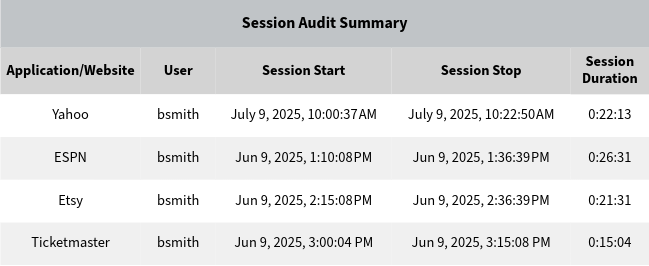
A Cyfin web use report showing reconstructed employee browsing sessions with recognizable site names, visit times, and session duration. Reports are formatted for management review without requiring any technical interpretation.
Who uses this
You need to know whether employees are using company internet access in ways that align with policy and support productivity. Cyfin gives you that visibility in reports you can read and act on independently, without waiting on IT for data interpretation.
Because Cyfin is agentless, you configure it once against your existing firewall with nothing to install on employee devices. After that, scheduled reports go directly to the managers who need them. You stop fielding ad-hoc web use reporting requests and management has the visibility it needs without ongoing IT involvement.
Common questions about employee web use monitoring
Why should organizations monitor employee internet use?
Organizations that monitor employee web use can write acceptable use policies based on actual usage data rather than generic boilerplate, verify that policies are being followed, and update policies as internet usage evolves. Without visibility, organizations cannot measure compliance, address productivity issues, or make informed decisions about the tools and access they provide to employees.
How does Cyfin produce human-only web use reports?
Cyfin's noise-filtering engine strips out all automated background traffic from firewall logs before generating reports, including operating system updates, software license checks, website trackers, and application background connections. What remains reflects only deliberate employee browsing behavior, making reports accurate and actionable for non-technical managers.
How should an acceptable use policy be created?
An effective acceptable use policy should be based on actual data about how employees in your specific organization use the internet, not generic boilerplate drafted without usage context. Organizations need visibility into current web use patterns to write a policy that addresses real behaviors, verify it is being followed after implementation, and update it as internet usage and technology evolve.
Related reading
Get Started with Cyfin
Tell us how we can help. Someone from our team will follow up within one business day.
- Response within one business day
- No credit card required for a free trial
- Talk directly with someone who knows the product